
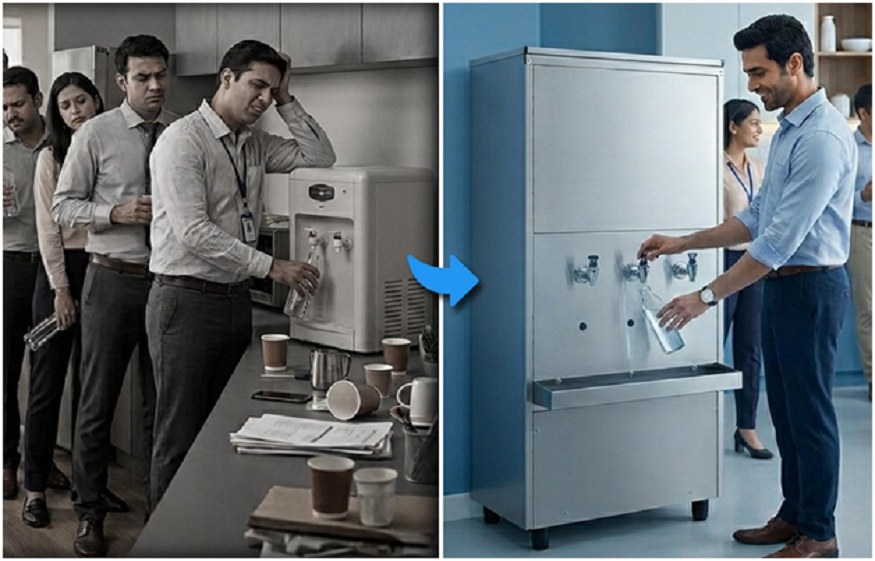
Around midday, when the office is at its busiest, the water cooler naturally becomes a checkpoint. People get up from their seats for a quick water refill. It is a small moment, but when the water cooler system does not function as it should, problems show up immediately!
Slow water dispensing, lukewarm water, or an empty tank during peak hours can disrupt routines more than expected.
However, in most of the cases, these issues do not come from poor quality of the RO water cooler, but stem from a mismatch between the system and the actual requirement. Selecting an appropriate water cooler means understanding the usage pattern of your establishment as it would then ensure consistent drinking water availability without any disruption.
Why the Right RO Water Cooler Matters in Commercial Spaces
In commercial environments, access to clean and safe drinking water is a basic expectation. Whether it’s employees, visitors, or customers. If an unsuitable system is in place, it can lead to certain issues. Like for instance, someone installed a RO water cooler at their office, having a capacity to support approximately 20-30 people, but their office has around 100 people, then naturally that system will suffer to meet the demand.
Read More : Planning to Buy a Water Softener? Keep These Installation Tips Handy
Similarly, in another case, if someone has installed a RO water cooler having high capacity then needed, it can lead to unnecessary water wastage, high expenses and the system might not function efficiently.
In both the cases, the result is almost similar, people might struggle to get safe and chilled drinking water with ease, which will then gradually translate into diminished productivity of the businesses.
We will now look at the things to keep in mind while choosing the right RO water cooler.
-
Understanding Your Requirement and Usage Pattern
Before choosing a system, it is important to look at how water is actually used in your space. The number of users, type of environment, and peak usage hours, all influence the kind of RO water cooler you need. For instance, an office setup will have a very different demand pattern compared to a hospital or a public facility where usage is continuous.
-
Getting the Right Capacity and Cooling Performance
Capacity is one of the most practical factors to consider. This includes both cooling speed and storage. Water coolers designed for high usage can handle peak demand without delays, while smaller setups may function efficiently with moderate storage. Choosing the wrong capacity often leads to either shortages during busy hours or inefficient energy use.
This could be understood with an example: offices in Delhi NCR face scorching heat in the summers, and people often come from far away to work. After travelling for a few hours, they might need a glass of chilled water, but if the system is not working properly, or the storage has run out of chilled water. This can further frustrate the employees and decrease their productivity at work.
Now, in the case of large establishments like factories, a small RO water cooler may not be sufficient. In such cases, an RO filter water plant is suitable. This will ensure safe and secure drinking water for all.
-
Understanding the Role of RO and Filtration Technologies
RO systems are essential in areas with high TDS, while additional stages like UV or UF help address microbial concerns. If your business lies in areas with high TDS levels, an RO water cooler can turn out to be a saviour.
If there is heavy microbial contamination, UV/UF technology is sufficient. Modern commercial RO water coolers come with an in-built 7-stage filtration technology, which can handle any kind of impurity.
It is always recommended to get your water quality tested before making a decision.
-
Build Quality and Suitability
Commercial water coolers are expected to run throughout the day. This makes durability important. Systems should be built with materials that can handle regular usage, resist corrosion, and maintain performance without frequent breakdowns.
-
Installation Requirements and Placement Considerations
Where and how the system is installed plays a key role in its performance. Adequate space, proper ventilation, and access to power and plumbing are essential. Placement should also allow for easy servicing and routine maintenance.
Read More : Understanding the Trade-Off Between Easy Access and Interest Rates
Conclusion
Choosing the ideal RO water cooler comes down to knowing what you really need as opposed to focusing solely on the features. When the requirements coincide with the capacity, quality, and consumption, the operation will be more effective and require fewer alterations.